
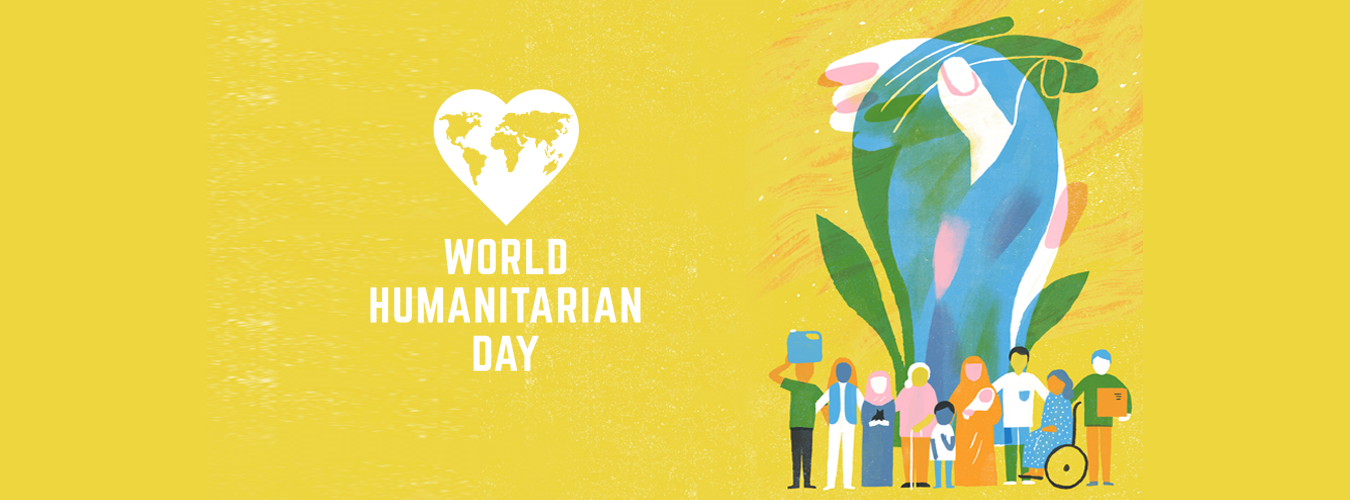
On August 19, 2022, the world celebrated the World Humanitarian Day under the theme #ittakesavillage. The United Nations was at the forefront of recognizing the thousands of volunteers, professionals and crisis-affected people who deliver urgent health care, shelter, food, protection, water and much more. These celebrations come amid increasingly complex and severe humanitarian crises in such places as Afghanistan, Venezuela, Yemen, Ukraine, across the East and Horn of Africa, and in the Sahel Region; when most often, local humanitarians face the brunt of violence targeting aid workers.
As the old African saying goes, “it takes a village to raise a child,” so does it take a “village” of volunteers, members of war-affected communities, national and international humanitarian workers, and private sector and public institutions to support individuals in humanitarian crises. As need for humanitarian response increases in many parts of the world, including in inherently fragile and conflict – affected states, so is the need to build the capacity of humanitarian actors (especially those whose role in the field has always been underestimated) to successfully deliver humanitarian action – despite the clear importance of local actors and the growing role of “grassroots humanitarians,” the international humanitarian system was built by and for international actors, multilateral organizations and international non-governmental organizations (NGOs). (Elling Tjønneland, 2020).
The humanitarian situation at a glance

The COVID-19 crisis pushed some of the main humanitarian crises on the planet into the background, despite the fact that the virus has actually made them worse. Crises ranging from armed conflicts to natural disasters proliferate because of climate change. The 2022 Global Risks Report published by the World Economic Forum predicts that climate change is a major driver of migration, a key element of humanitarian crisis. Climate change displaces people directly because of natural disasters and it can displace them indirectly by encouraging economic migration from weakening economies vulnerable to the adverse impacts of climate change. The inability to adapt to or mitigate the impacts of climate change threaten to make certain densely populated parts of the world uninhabitable.
The global humanitarian situation is not predicted to get any better in the advent of climate change. As such, Humanitarian action must adapt to the climate crisis. We cannot risk overlooking other threats while we fight the climate crisis.
Conflict and political insecurity are also major drivers of humanitarian crisis. In 2020, there were over 34 million people displaced abroad globally from conflict alone—a historical high — mostly due to long-standing conflicts and political turmoil in Afghanistan, Myanmar, South Sudan, Syria and Venezuela, and to expanding conflicts within and beyond the borders of Ethiopia. Political turmoil may well worsen in the aftermath of the COVID-19 pandemic, compounded by the reduction of international security forces from conflict zones such as Afghanistan and the Sahel region of Africa (Global Risks Report, 2022).
#ItTakesAVillage
Capacity building has a natural place in disaster cycles, and in the past this provided a logical basis for deciding who should have their capacity built to do what, and when. The actual ebb and flow of investments in capacity building have regrettably not followed this seemingly self-evident cycle. Agencies need to scale up considerably to meet the demands for large-scale impactful humanitarian response. The search for local ‘surge capacity’ means that institutions are rented rather than built. Resources and time for investments in skills that are needed before a humanitarian crisis paradoxically tend to be more readily available in the aftermath of a major crisis, just when local agencies are laying off staff at an equally frenzied pace. Perhaps the most obvious issue in local capacity building is one that many agencies do not discuss at all. Nationally recruited staff members are in the majority in most humanitarian organizations, but they are often all but invisible in human-resource management. Too many agencies still implicitly look on expatriates as the norm (Ian Christopolos, 2004).
In 2021, local actors were critical to and at the forefront of the response to COVID-19, particularly in sustaining humanitarian operations. Steady progress has been made in localization, backed up by sustained political support. International actors are making changes, particularly in the flexibility of partnership agreements, to better support local leadership and delivery. It is critical to continue strengthening principled engagement with national/local authorities to ensure a more relevant and sustainable response.
Capacity building strengthens the ability of the humanitarian sector to provide aid effectively. It equips organizations to adjust well to the latest developments in the sector, improve the quality of response, test new approaches or adopt new ways of working, scale-up innovation, and improve cooperation and collective response to crises. Through capacity building, humanitarian organizations share knowledge, expertise and good practices to react better and faster to emergencies. In turn, working in a coordinated and complementary way will help them respond to humanitarian needs effectively and efficiently. The United Nations estimates that 274 million people will need humanitarian assistance in 2022. This is an increase of almost 40 million people from 2021 estimates. Thus, the gap between humanitarian needs and the resources available globally is increasing (DG-ECHO, 2022)
Humanitarian organizations, both local and global, need to learn to operate in the face of new challenges and better cooperate to maximize their impact on those in need.
This article was first published on LinkedIn by Israel Atsango, Lead Editor – Ideas Plus on August 20, 2022
Well backed up points and yes, local communities are important stakeholders that are often overlooked but who can drive the sustainable development agenda, humanitarian interventions in this case.