

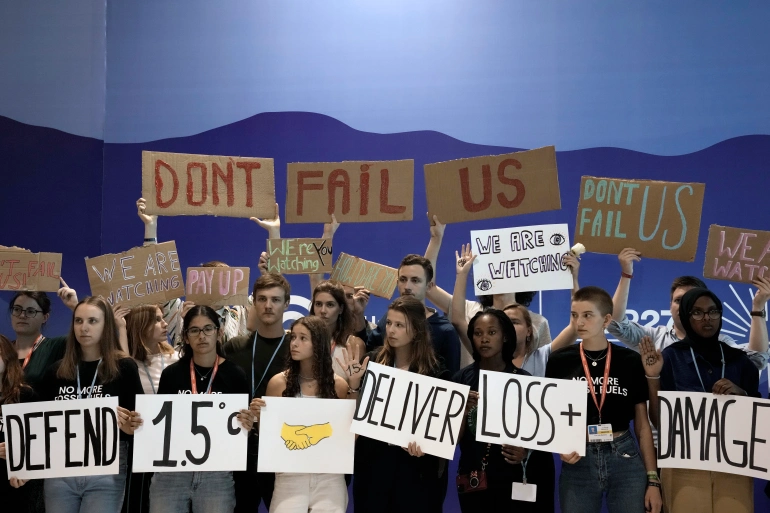
COP27 brought together more than 45,000 participants to share ideas, solutions, and build partnerships and coalitions. Indigenous peoples, local communities, cities and civil society, including youth and children, showcased how they are addressing climate change and shared how it impacts their lives. The 2022 UNFCCC Conference of Parties will go down in history as the UN climate change conference where the Loss and Damage fund was agreed. After decades of pushing, the creation of the fund was a momentous victory for climate-vulnerable developing countries. Creating a specific fund for loss and damage marked an important point of progress, with the issue added to the official agenda and adopted for the first time at COP27.
Acceptance of the need to create such a fund was one of the key developments from the summit. Pressure from developing nations was spearheaded by Pakistan, a country reeling after exceptional floods killed over 1,700 people, left over two million people displaced and cost the country €39 billion.
The fund isn’t without controversy though, with critics questioning the definition of developing countries that was used in negotiations, as it is based on a 1992 agreement. Many countries have seen significant growth since then, and it seems to many observers to be unfair for countries such as China, Saudi Arabia and Russia, which are major greenhouse gas emitters, to not be considered wealthy enough to contribute to this new fund to help those most impacted by climate change. The US climate envoy, John Kerry, arrived at COP27 opposing such a fund, and claimed that existing funds could pay for climate-related losses and damages. US negotiators also opposed the principle that high emitters should accept liability for their historical emissions, fearing this could lead to claims running potentially into trillions of dollars. The European Union was also skeptical initially, but eventually changed its position, which put pressure on the US to follow.
What’s next?
According to a statement released by Dr. Farah Naureen, Mercy Corps’ Country Director for Pakistan, the loss and damage fund is undoubtedly a welcome breakthrough and an essential step forward to build more resilient societies but it will only be effective if it goes hand in hand with efforts to mitigate and adapt. Without rapid and effective mitigation and adaptation programs, the impacts of climate change will be too destructive to be covered by any fund. At COP27, there was a shocking lack of ambition and progress on mitigation and adaptation, including efforts to increase climate finance.
The science is clear – every fraction of a degree will push the limits of adaptation. COP27, being held in the most vulnerable continent to global warming, had the opportunity to raise political attention and push for adaptation action. The request for a report on the commitment to double adaptation finance – with space for developing countries to respond to that report – is a welcome boost of confidence around meeting that goal as well as significant contributions to the adaptation fund. However, the final deal does not reflect the urgency needed to support adaptation efforts worldwide, but in particular in the most vulnerable regions. Despite COP27 recognizing the need for transformation of the financial system in order to finance the transition and resilience needs of developing countries, there was little new money on the table.
Parting shot
In order to ensure a safe and resilient world, support for Loss and Damage must be scaled up significantly in addition to the fulfillment of promises to ensure balance between mitigation and adaptation and provide support for adaptation inscribed in the UNFCCC’s Sharm el-Sheikh Implementation Plan and its Paris Agreement. This support must be provided in the form of grants such that addressing loss and damage does not violate their human rights, increase the debt loads and poverty levels of people, communities and countries already coping with multiple crises simultaneously.